

The history of the hair clipper: from flint blades to cordless Wahl
Lime Light Hair & Beauty · 27 November 2026 · 6 min read

Every fade, taper and buzz cut today depends on one tool: the hair clipper. But for thousands of years, barbers had nothing but blades, scissors and a steady hand. Here is the story from Stone Age flint and Egyptian copper razors to medieval barber-surgeons, how the hair clipper was invented, how Leo J. Wahl put a motor in the barber's hand, and how today's cordless clippers came to be.
Published 23 April 2027 by Lime Light Hair & Beauty Products.
The quick answer
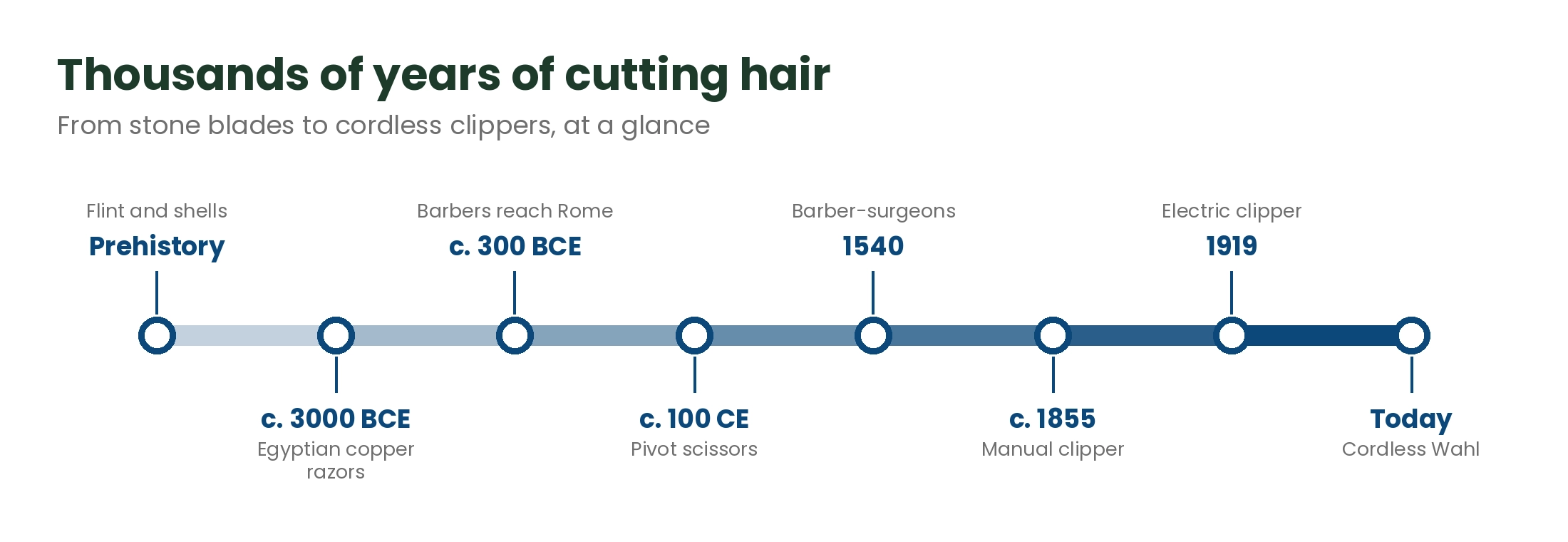
Ancient times: hair was cut with flint, shells, then Egyptian copper razors and spring shears. The Romans gave us pivot scissors.
Middle Ages: barber-surgeons cut hair, shaved and even pulled teeth.
c. 1855: Serbian barber Nikola Bizumić is credited with inventing the manual hair clipper.
1919: Leo J. Wahl applied for patents on the first practical electric clipper, with the motor in the hand.
1960s: Wahl brought out vacuum clippers and its first cordless, rechargeable trimmer for professionals.
Today: barbers use powerful cordless clippers and trimmers like the Wahl 5 Star series.
How did people cut hair before clippers?
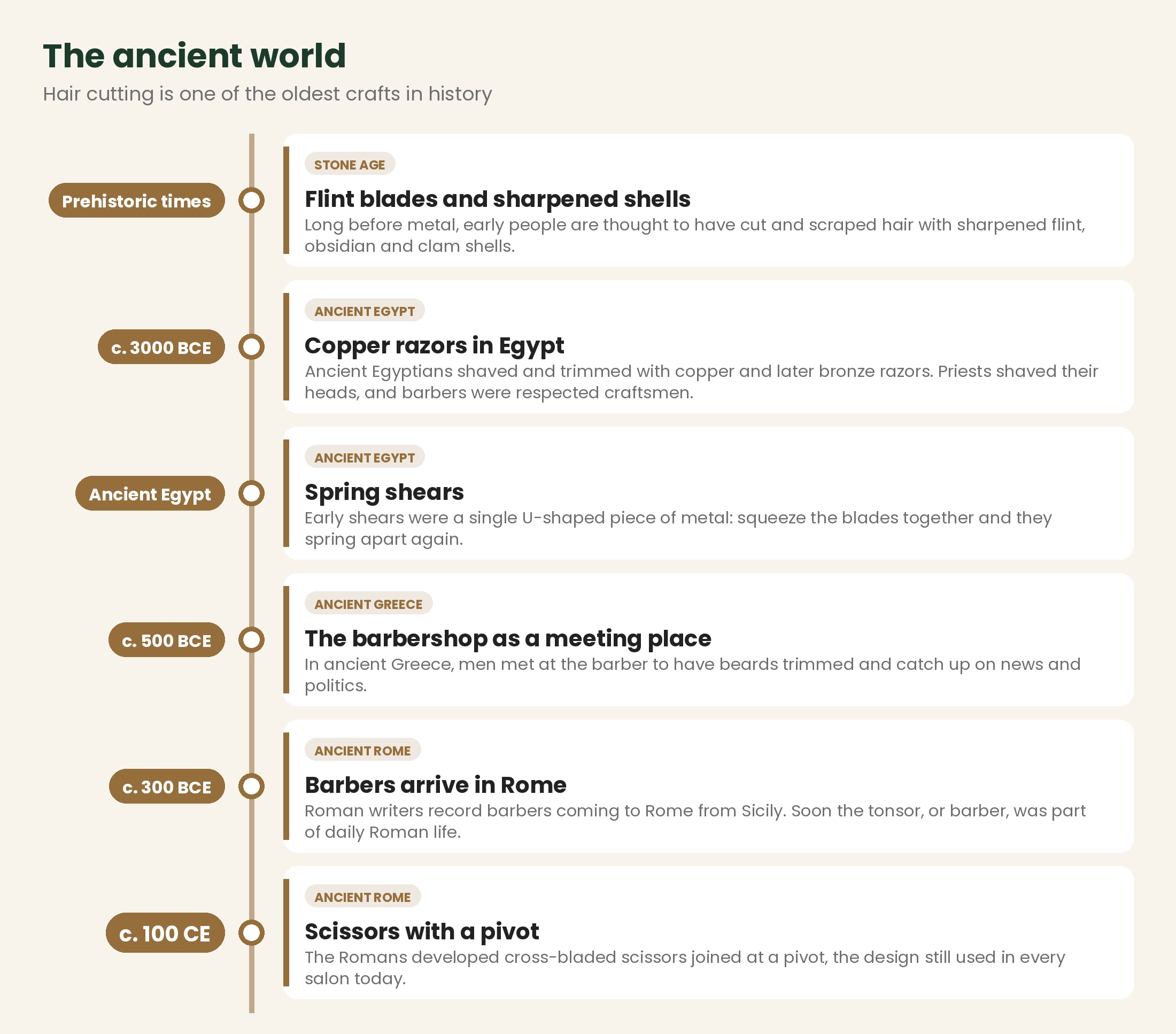
Cutting hair is one of the oldest crafts in the world. Long before metal, people are thought to have used sharpened flint, obsidian and shells. By around 3000 BCE, Egyptians were shaving and trimming with copper razors, and their barbers were respected craftsmen. Early spring shears, a single U-shaped strip of metal, came next.
In ancient Greece the barbershop became a meeting place for news and politics. Roman writers record barbers arriving in Rome from Sicily around 300 BCE, and around 100 CE the Romans developed scissors with a pivot, the same basic design used in every salon today.
Who were the barber-surgeons?
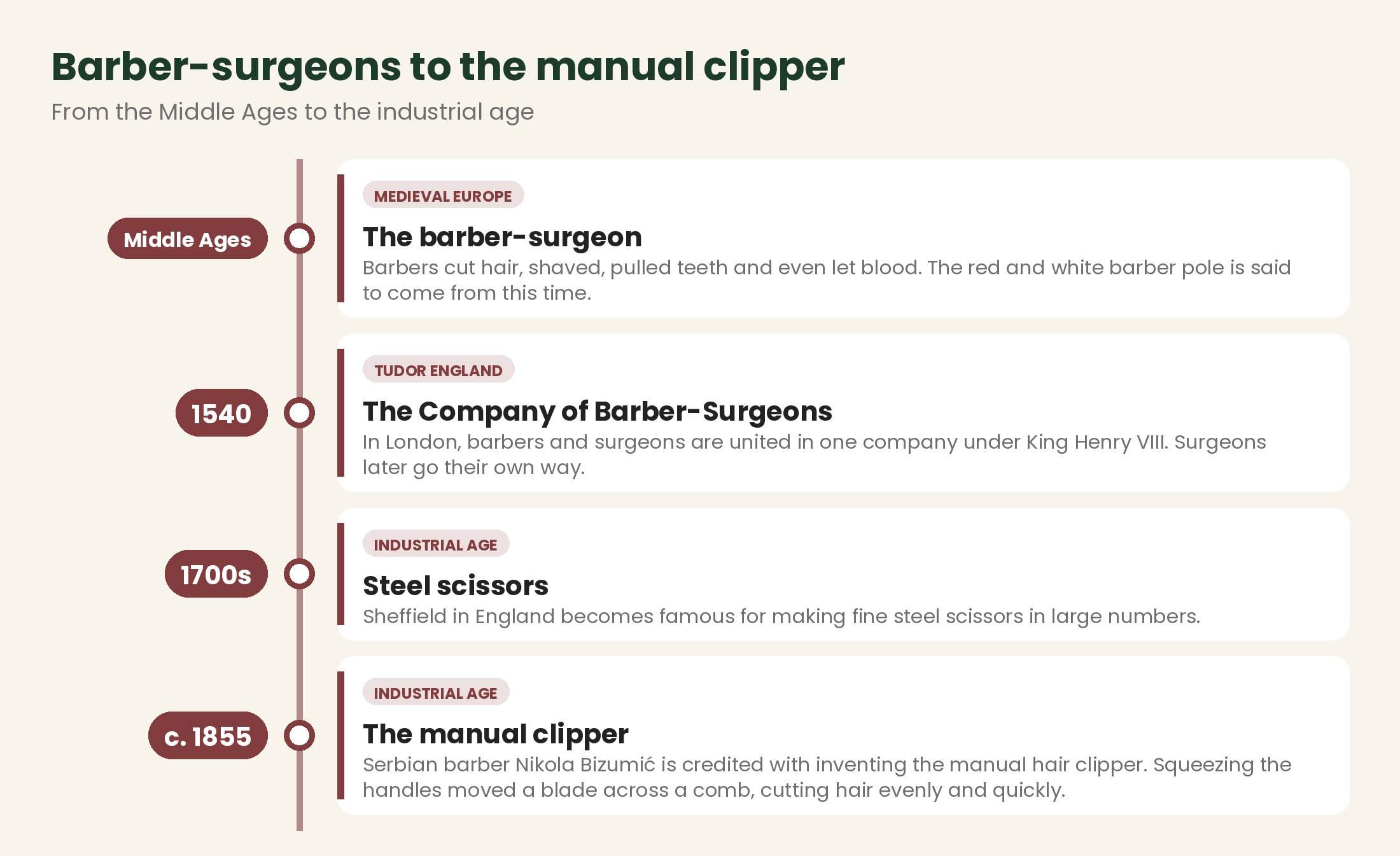
In the Middle Ages, barbers did far more than cut hair. They shaved, pulled teeth and even let blood, which is where the red and white barber pole is said to come from. In 1540, barbers and surgeons in London were joined into one company under King Henry VIII, before surgeons later went their own way. By the 1700s, cities like Sheffield were making fine steel scissors in large numbers.
Who invented the hair clipper?
The manual hair clipper is credited to Nikola Bizumić, a Serbian barber, around 1855. His tool worked like a pair of scissors with a comb attached: squeezing the handles moved a toothed blade across a fixed comb, cutting hair to an even length far faster than scissors alone.
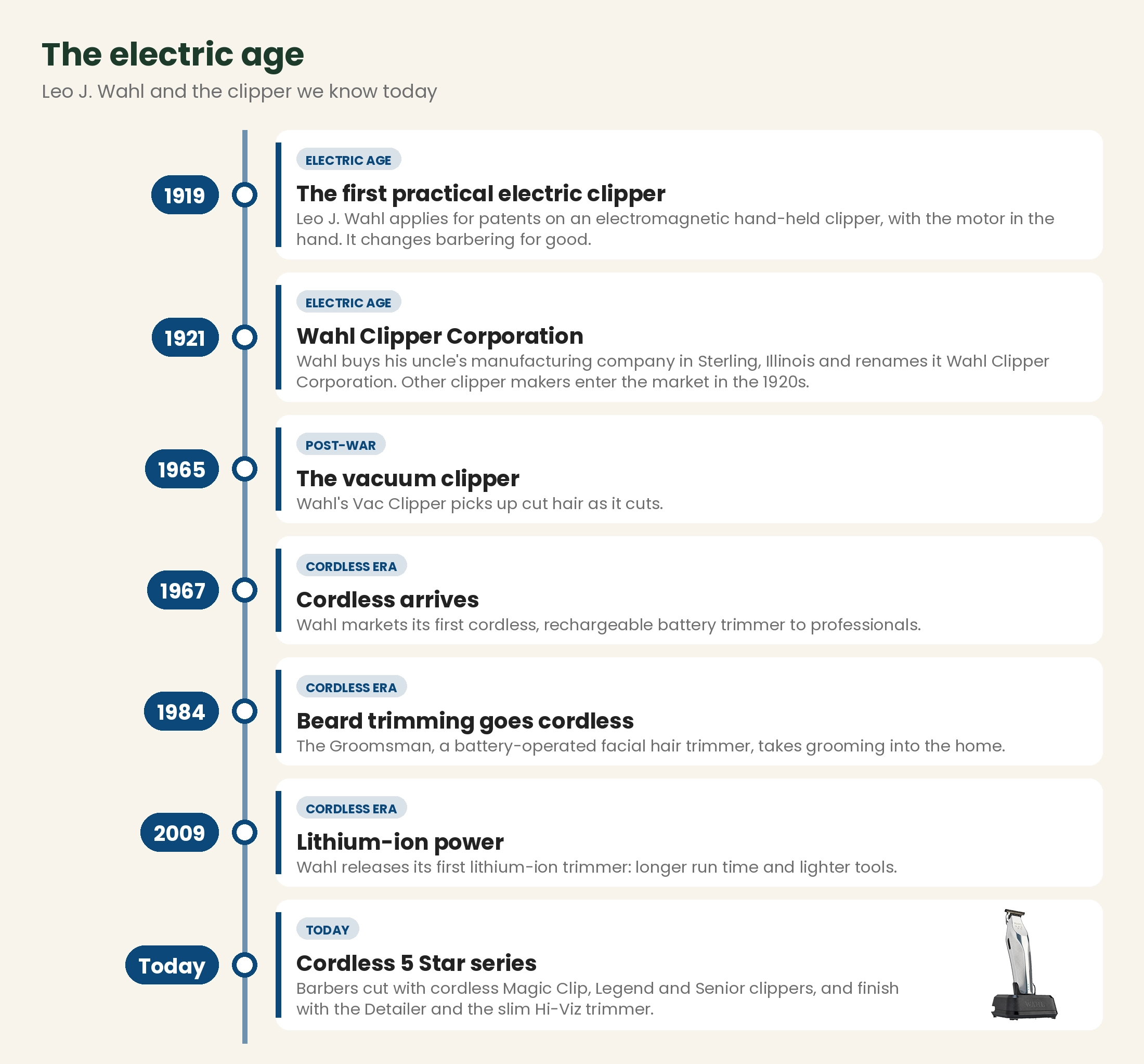
The electric hair clipper came from Leo J. Wahl in the United States. In 1919 he applied for patents on an electromagnetic hand-held clipper, which Wahl describes as the first practical clipper with the drive motor in the hand.
How did the electric clipper change barbering?
Leo Wahl started out improving a hand-held massager for his uncle's company in Sterling, Illinois. The small, powerful motor he developed was perfect for a clipper. In 1921 he took over the company and renamed it the Wahl Clipper Corporation. Other famous clipper makers entered the market during the 1920s, and the electric clipper quickly became the heart of every barbershop.
When did cordless clippers arrive?
According to Wahl, it marketed its first cordless, rechargeable battery-operated trimmer to professionals in 1967. Battery technology has improved enormously since then. Wahl released its first lithium-ion trimmer in 2009, and today's cordless clippers can run a full day of cuts and charge quickly between clients.
Hair clipper history at a glance
| When | What happened | Why it mattered |
|---|---|---|
| Prehistory | Flint, obsidian and shells | The first ways to cut and shape hair |
| c. 3000 BCE | Copper razors in Egypt | Metal tools and respected barbers |
| c. 300 BCE | Barbers arrive in Rome | The barber becomes part of daily life |
| c. 100 CE | Pivot scissors (Rome) | The scissor design still used today |
| Middle Ages | Barber-surgeons | Barbers shave, cut and treat |
| 1540 | Company of Barber-Surgeons, London | Barbering becomes an organised trade |
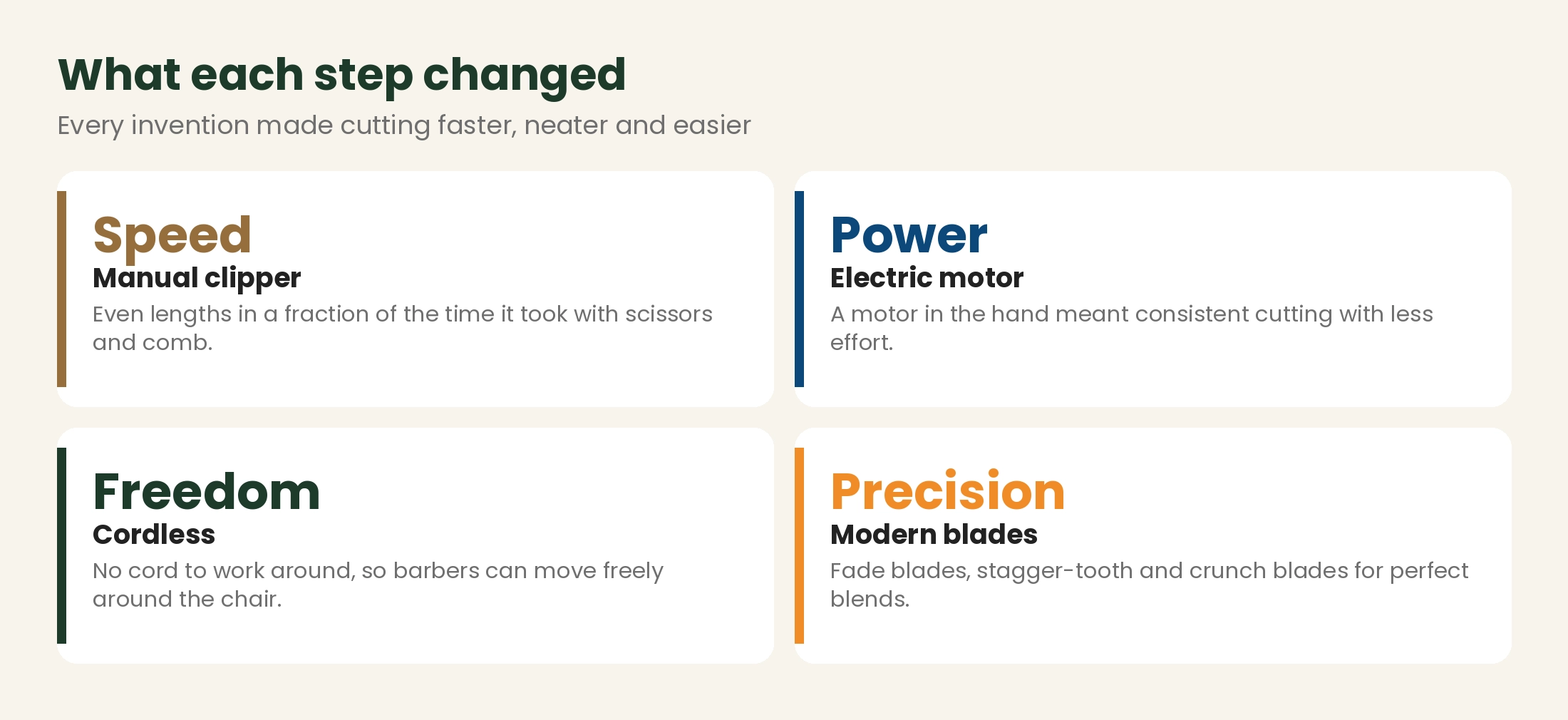
| c. 1855 | Manual clipper (Nikola Bizumić) | Fast, even lengths by squeezing the handles |
| 1919 | Electric clipper patents (Leo J. Wahl) | A motor in the hand: less effort, more consistency |
| 1921 | Wahl Clipper Corporation formed | Electric clippers go mainstream |
| 1965 | Vac Clipper | Picks up hair while cutting |
| 1967 | First cordless trimmer for pros | Freedom from the cord |
| 1984 | Groomsman facial hair trimmer | Grooming moves into the home |
| 2009 | First lithium-ion trimmer | Lighter tools, longer run time |
| Today | Cordless 5 Star series | Fades, blends and detail with full freedom |

What clippers do barbers use today?
Modern barbers usually work with a set of tools: a clipper for bulk and fades, a trimmer for line-ups and detail, and a shaver for a skin-smooth finish. The Wahl 5 Star series covers all three.
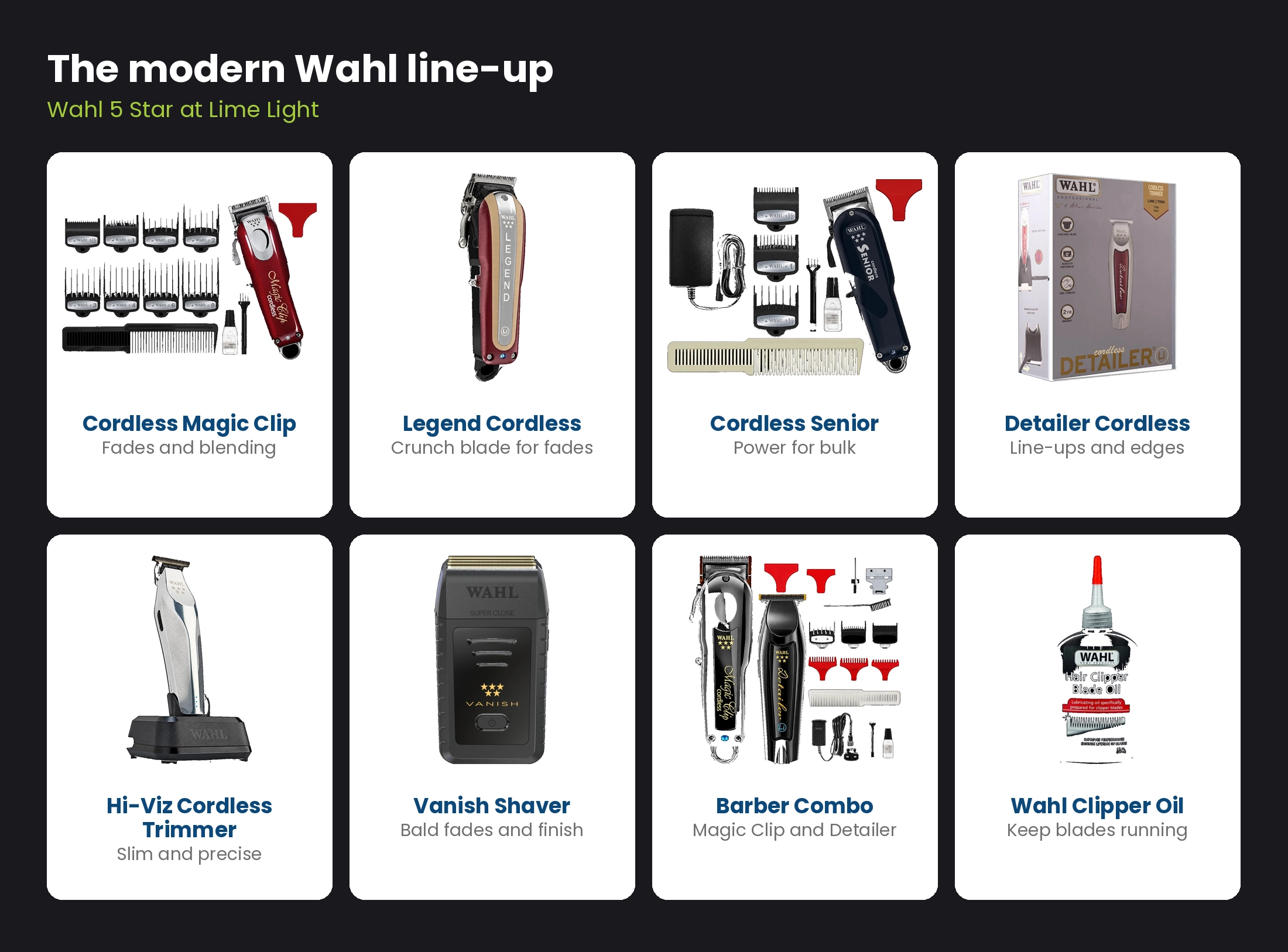
- Cordless Magic Clip: stagger-tooth blade for fades and texture.
- Legend Cordless: crunch blade for seamless blending.
- Cordless Senior: power for bulk removal through thick hair.
- Detailer and Hi-Viz: crisp line-ups and edges, with the slim Hi-Viz giving a clear view of your work.
- Vanish Shaver: a smooth finish for bald fades.
Not sure which to choose? Read Which Wahl clipper is best? and keep them sharp with our Clipper care guide.
Wahl at Lime Light
Lime Light stocks the Wahl 5 Star range, blades, guards and clipper oil, with Wahl service centres to keep your tools running. Spread the cost of new clippers with Payflex at our online checkout.
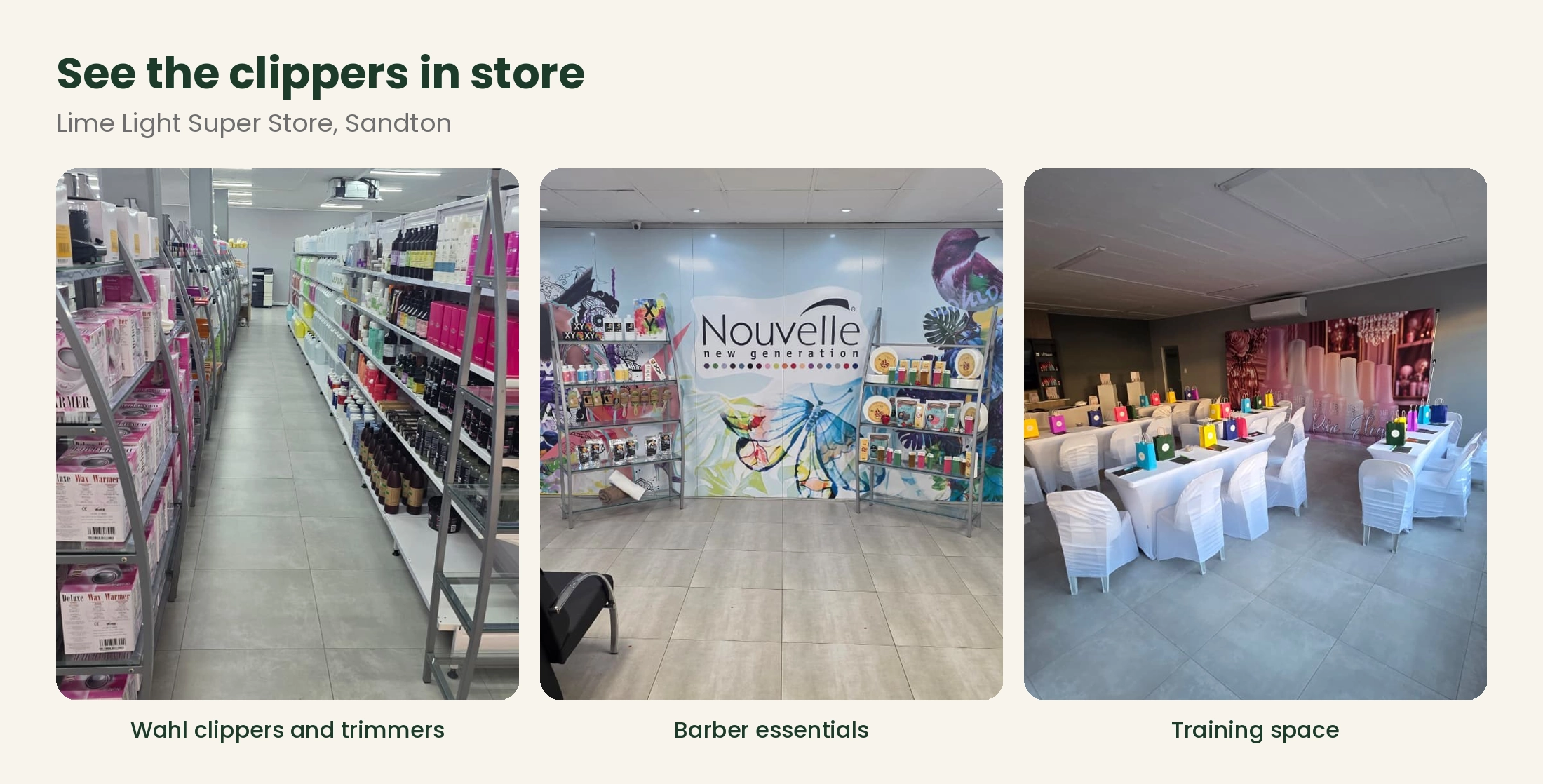
See and hold the full Wahl range at the Lime Light Super Store, the largest showroom of its kind in South Africa for dedicated wholesale hair and beauty products, at Block B, Tripark, 17 Eastern Service Road, Kelvin, Sandton.
Frequently asked questions
How did people cut hair before clippers?
With sharpened stones and shells in prehistoric times, then copper razors, spring shears and, from Roman times, pivot scissors and a comb.
Why is the barber pole red and white?
It is said to date from the Middle Ages, when barber-surgeons also let blood. The red and white are often linked to bandages.
Who invented the electric hair clipper?
Leo J. Wahl, who applied for patents on an electromagnetic hand-held clipper in 1919 and founded the Wahl Clipper Corporation in 1921.
Who invented the manual hair clipper?
Serbian barber Nikola Bizumić is credited with inventing the manual hair clipper around 1855.
When were cordless clippers invented?
Wahl says it marketed its first cordless, rechargeable trimmer to professionals in 1967. Modern lithium-ion batteries arrived in Wahl trimmers in 2009.
What is the difference between a clipper and a trimmer?
A clipper has a wider blade for cutting bulk and fading. A trimmer has a narrower, finer blade for outlines, line-ups and detail.
Is Wahl still the leading clipper brand?
Wahl has been making clippers for over 100 years and its 5 Star series is a favourite in barbershops around the world.
Where can I buy Wahl clippers in South Africa?
At Lime Light: online at limelighthb.co.za, at the Lime Light Super Store in Sandton, and at our branches in Boksburg, Cape Town and Durban.
Shop Wahl with Lime Light
- Shop online: limelighthb.co.za, under Electrical.
- Visit the Super Store: Block B, Tripark, 17 Eastern Service Road, Kelvin, Sandton.
- Open a trade account: visit our website and hit register, fill in the details and we will approve your account.
- Call us: 011 262 2451 | Email: shop@limelighthb.co.za
More from the blog
 Which Wahl clipper is best? The 2027 buyer's guide to Wahl 5 Star clippers, trimmers and shaversCompare Wahl 5 Star clippers, trimmers and shavers: Magic Clip vs Legend, Senior, Balding, Detailer, Hi-Viz and Vanish. Find the best Wahl kit and buy in South Africa.
 How to clean, oil and look after your clippers: the barber's maintenance guideHow to clean, disinfect and oil hair clippers between clients, deep clean them weekly, when to replace blades and foils, and where to get Wahl clippers serviced in South Africa.
 The history of hair removal wax: from Stone Age shells to Depilève film waxHow waxing developed, from ancient sugar pastes to the first strip wax in 1972 and Depilève film wax in 2003, plus strip, roll-on and film wax explained.