

Gel nail allergies explained: HEMA, uncured gel and how to stay safe
Also called gel nail allergy, HEMA allergy, acrylate allergy, methacrylate allergy, gel polish allergy, itchy fingers after gel, nail technician allergy, uncured gel
Gel and acrylic nails are safe when they are applied and cured properly. But when uncured product touches the skin again and again, some people develop an allergy, and once someone is allergic it usually lasts for life. The good news is that good technique prevents most of it.
The quick answer
- Cause: uncured (meth)acrylates, such as HEMA, touching the skin.
- Signs: itching, redness, swelling or a rash around the nails, fingers or face.
- Biggest risks: gel on the skin, thick coats and under-curing.
- Prevent: thin coats, clean edges, a full cure in the right lamp.
- Technicians: wear gloves and keep product off your own skin too.
What you will learn
Nail technician path- Explain what (meth)acrylates and HEMA are
- Recognise the signs of a gel nail allergy
- Prevent allergies with good application and curing
What causes gel nail allergies?
Gel polish, builder gel and acrylic contain (meth)acrylates, the ingredients that harden into a strong coating. Once fully cured they are stable, but uncured product can cause an allergy when it touches the skin. The British Association of Dermatologists has warned about rising (meth)acrylate allergies linked to acrylic nails, gel nails and gel polish, and says home kits and insufficient curing increase the risk.[1]
What is HEMA?
HEMA (2-hydroxyethyl methacrylate) is one of the (meth)acrylates used in many nail products. In patch testing studies it is the one most often found to cause reactions. Dermatologists say sensitisation can happen when uncured products come into contact with any part of the skin.[2]
What are the signs of a gel nail allergy?
- Itching, redness or swelling around the nails and fingertips.
- A rash or blisters on the fingers.
- The nail loosening from the nail bed.
- Itchy, swollen eyelids or a rash on the face or neck, from touching the face.
How do you prevent gel nail allergies?
- Keep product off the skin: leave a tiny gap at the cuticle and sidewalls.
- Apply thin coats so each layer cures all the way through.
- Cap the free edge without flooding the skin.
- Clean up any product on the skin before curing.
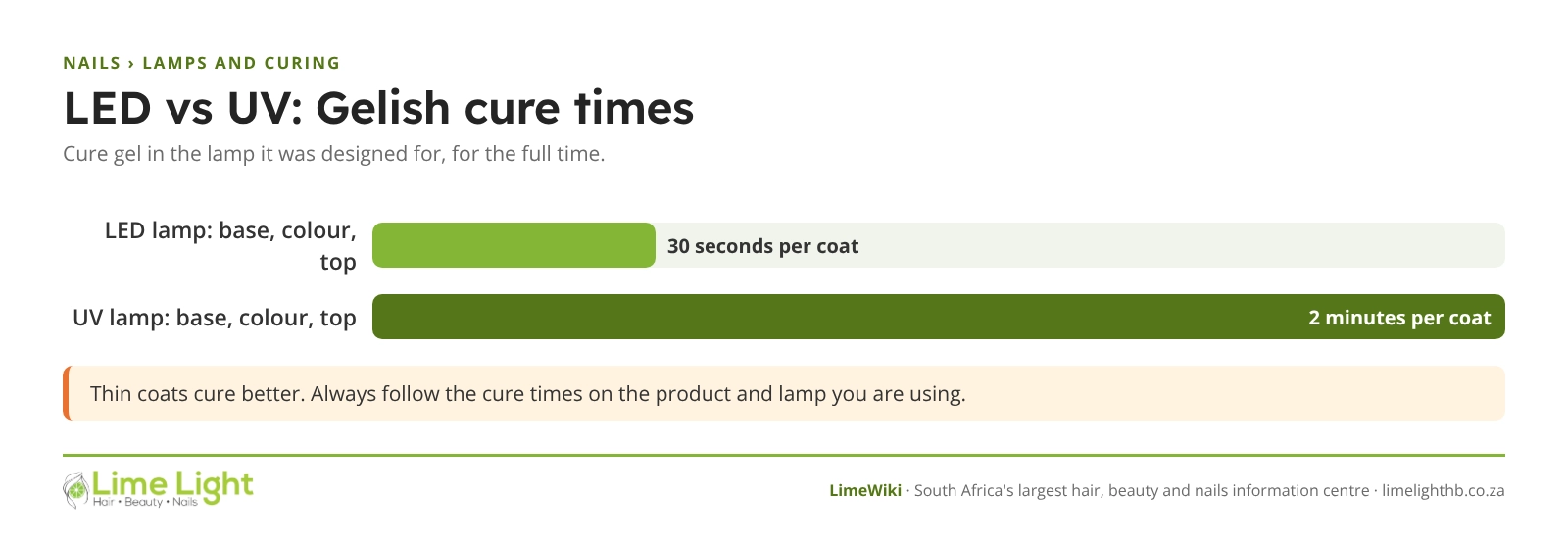
- Cure fully for the time the brand recommends, in a compatible lamp.
- Don't touch uncured gel on brushes, wipes or the sticky layer with bare skin.
Using a matched system, like Gelish gel with the Gelish 18G Plus LED Light, helps make sure every layer cures properly. See LED and UV lamps: curing explained.

How can nail technicians protect themselves?
Technicians are exposed every day, so they are at risk too:
- Wear nitrile gloves, and change them if product gets on them.
- Never touch uncured gel or acrylic liquid with bare skin.
- Keep the work area ventilated and close bottles straight away.
- Clean spills and the sticky layer with a proper cleanser and lint-free wipes.

Which gel safety products does Lime Light stock?
- Gelish 18G Plus LED Light for a full, even cure.
- Gelish Foundation and the full Gelish system.
- Gelish Cleanser and Nailz IPA for removing the sticky layer.
- Nitrile gloves.

Safe gel station kit

Delivery
The delivery day for your address, and the time to order by, show at checkout as soon as you enter your address. You can also collect from any branch.
Ways to pay at Lime Light
- Card or instant EFT through PayFast
- Payflex, in four payments
Shop at Lime Light
- Shop online: search the shop for “Gelish”
- New to Lime Light? Create an account on the website.
- Email: shop@limelighthb.co.za
- Lime Chat: ask a consultant from the chat button on any page.
Lime Light Sandton (Superstore)Block B, Tripark, 17 Eastern Service Road, Kelvin, Sandton, 2090
Mon-Fri 08:00-17:00 (closed weekends & public holidays)
Lime Light BoksburgThe Terminal Centre, 191 Dr Vosloo Rd, Bartlett, Boksburg, 1459
Mon-Fri 08:00-17:00 (closed weekends & public holidays)
Hands Down M5 ParkUnit 5, M5 Business Park, Eastman Road, Maitland, Cape Town, 7405
Mon-Fri 08:30-17:00; Sat 08:30-12:30
Beautiquip DurbanGate 4, 106 Avondale Rd, Essenwood, Berea, Durban, 4001
Mon-Fri 08:00-17:00 (closed weekends & public holidays)
Sparkle Cape TownBuilding 3, Waverley Business Park, Wyecroft Road, Mowbray, Cape Town
Mon-Fri 08:00-17:00 (closed weekends & public holidays)
Frequently asked questions
Can you become allergic to gel nails?
Yes. Repeated skin contact with uncured gel can cause an allergy, which usually lasts for life.
What is HEMA?
A (meth)acrylate used in many nail products. It is a common cause of nail-product allergies when it touches the skin uncured.
Are home gel kits riskier?
Dermatologists warn that home kits and insufficient curing can increase the risk of developing an allergy.
What are the signs of a gel allergy?
Itching, redness, swelling or rash around the nails, and sometimes on the eyelids, face or neck.
How can I prevent a gel allergy?
Keep gel off the skin, apply thin coats, cure fully in the right lamp, and wear gloves if you are a technician.
Where can I buy Gelish in South Africa?
At Lime Light: online at limelighthb.co.za, at the Lime Light Super Store in Sandton and at our branches in Cape Town and Durban.
Quick check: 5 questions
Score 4 out of 5 to pass. Take it as often as you like.
Was this helpful?
Comments
Questions and tips from other salons. The Lime Light education team checks each comment before it shows.
Sign in to commentAsk a question or share a tip with other salons. You come back to this article after signing in.Sign in
See also
- LED and UV lamps: curing explained
- How to apply gel polish step by step (Gelish)
- Why gel polish lifts
- Lash extension glue explained: drying time, humidity, retention and aftercare (LASHGAZZM)
- Client consultation and patch testing: the salon safety guide
- Myth busters: 10 hair, nail and beauty myths your clients still believe
What links here
References
- Dermatologists issue warning about UK artificial nail allergy epidemic
British Association of Dermatologists, checked 2026-11-23 - Dermatologists issue fresh warning about safe use of gel systems following increase in allergies
Professional Beauty, checked 2026-11-23
Who made this article
- Written by
- Lime Light Education
- Uploaded
- 2026-11-24 13:00
- Checked by
- Sami Bruce, 24 Nov 2026
- Version
- 1.1 · Updated · See all changes
Smart Terms in this article
cureHEMAgel polishacrylic nailspatch testnail bedcuticleside wallscapping the free edgeinhibition layerGelishcleansernitrile glovestrade accountbuy now, pay laterPayflexLime ChatLime Light Super Store