FROM R134.30 WHEN YOU BUY 6How to cover grey hair
Also called grey coverage, covering grey, gray coverage, resistant grey, grey blending
Published 23 Nov 2026 · Written by Lime Light Education · Checked by Brendan · 5 min read · Professional

Grey coverage is the most booked colour service in most salons, and the one clients notice first when it goes wrong. Grey that looks see-through after a week, or a front hairline that will not take, usually comes down to three things: the shade, the developer and the timing. Here is how to get it right every time.
The quick answer
- Use permanent colour for full coverage. Demi-permanent blends grey but does not fully cover it.
- Read the grey first: estimate the percentage and look for resistant, glassy grey at the hairline and temples.
- Add natural: use a .0 or .00 shade, or mix a natural shade into fashion shades, for stronger coverage.
- Use 20 vol (6%) and the full development time. Do not rinse early.
- Shop: Dikson Color Extra .00 Extra shades and Dikson OXY 20 vol at Lime Light.
What you will learn
Colour basics path- Estimate how much grey a client has and why it matters
- Choose the right shade, natural base and developer for full coverage
- Handle resistant grey and offer grey blending as an alternative
Why is grey hair harder to colour?
Grey hair has lost its natural pigment (melanin), so there is nothing underneath to support the new colour. It is often also coarser, with a tighter, smoother cuticle that is slower to open. That is why grey hair can look lighter or more see-through than the rest of the head after colouring, and why it needs extra natural pigment and enough time to develop.[1]
How much grey does my client have?

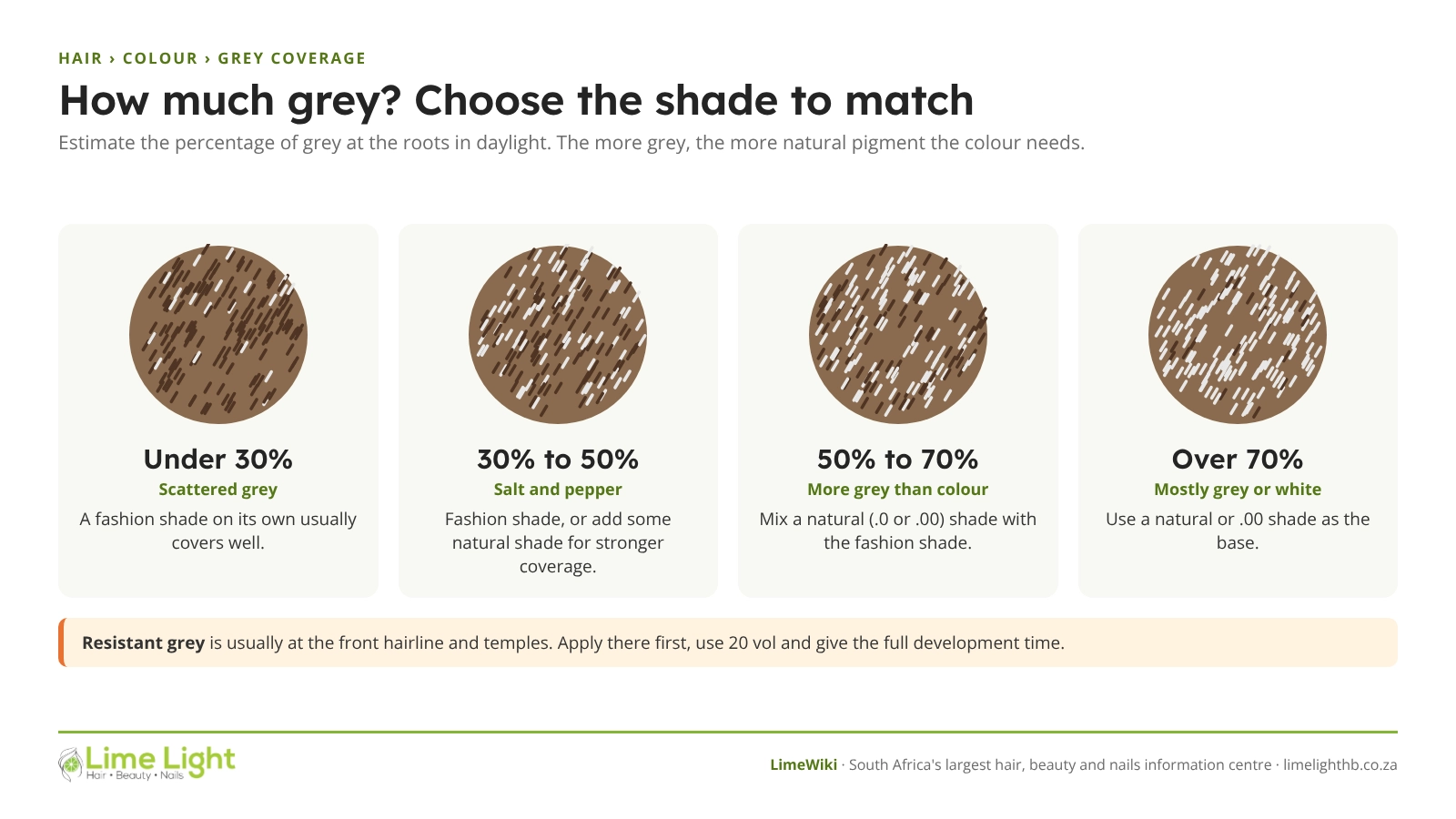
Look at the roots in daylight and estimate the percentage of grey. It changes the shade you choose.
| Grey | What it looks like | What to use |
|---|---|---|
| Under 30% | Scattered grey hairs | Fashion shade on its own usually covers well |
| 30% to 50% | Salt and pepper | Fashion shade, or add some natural shade for stronger coverage |
| 50% to 70% | More grey than colour | Mix a natural (.0 or .00) shade with the fashion shade, as the brand chart advises |
| Over 70% | Mostly grey or white | Use a natural or .00 shade as the base; fashion tones only as an accent |
How do I cover grey hair, step by step?

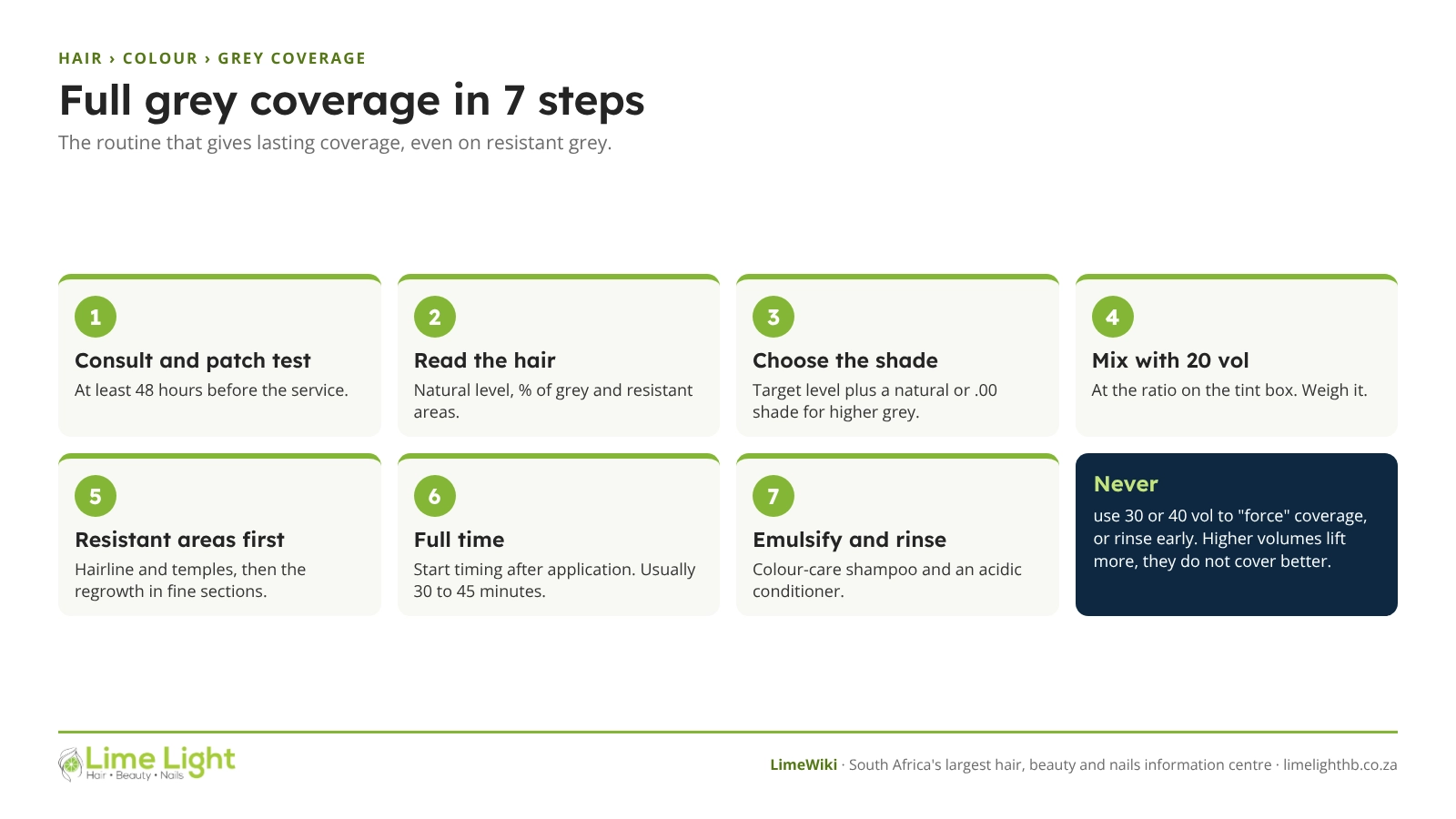
- Consult and patch test at least 48 hours before (see Patch testing before a colour service).[2]
- Read the hair: natural level, percentage of grey, and where the resistant areas are.
- Choose the shade: match the target level, and add a natural or .00 shade for higher percentages of grey. Going one level darker than the natural colour often gives a richer result.[3]
- Mix with 20 vol (6%) at the ratio on the tint box. Weigh, do not guess.
- Apply to the most resistant areas first: usually the hairline and temples, then the rest of the regrowth in fine sections.
- Time it fully: start the clock when application is finished and give the full development time on the brand's chart, usually 30 to 45 minutes.
- Emulsify and rinse: add a little warm water and massage at the basin before rinsing, then use a colour-care shampoo and an acidic conditioner.
FROM R134.30 WHEN YOU BUY 6What if the grey still will not cover?
Resistant grey has a very tight cuticle. These steps help:
- Use a natural base: more natural pigment means stronger coverage. Dikson's .00 Extra shades are made for this.
- Do not lower the developer: 10 vol does not open resistant grey enough. Stay on 20 vol.
- Keep the full time: shortening development is the most common reason grey shows through.
- Pre-soften (on advice): some colourists pre-soften very resistant grey before tinting. Ask your colour educator or the brand's technical team before trying it.
FROM R89.25 WHEN YOU BUY 6Can I blend grey instead of covering it?
Yes, and many clients prefer it. Grey blending uses demi-permanent colour, often one or two levels lighter than the natural shade, to soften grey so it melts into the natural colour. The regrowth is far less obvious, so it suits clients who do not want a root touch-up every four weeks. See Permanent vs demi-permanent hair colour.
For men, a quick blend with a demi-permanent colour keeps grey looking natural and is popular in barbershops.
Which grey coverage products does Lime Light stock?
- Dikson Color Extra .00 Extra shades: from 3.00 to 10.00, with extra natural pigment for stronger grey coverage, plus over 100 fashion shades.
- Dikson OXY Cream Peroxide 20 Vol: the everyday developer for Color Extra.
- KADUS Demi: ammonia-free demi-permanent colour for grey blending.
- KADUS Toneplex Grey Mask: a toning mask to keep grey and silver hair bright between visits.
- American Crew Daily Silver Shampoo: for men with grey and silver hair.

Grey coverage kit
FROM R134.30 WHEN YOU BUY 6
FROM R89.25 WHEN YOU BUY 6


Shop at Lime Light
- Shop online: search the shop for “Color Extra .00”
- New to Lime Light? Create an account on the website.
- Email: shop@limelighthb.co.za
- Lime Chat: ask a consultant from the chat button on any page.
Frequently asked questions
Why does grey hair look lighter after colouring?
Grey has no natural pigment to support the colour. Add a natural or .00 shade and give the full development time.
What developer is best for grey coverage?
Usually 20 vol (6%). Lower volumes do not open resistant grey enough, and higher volumes lift more than they cover.
Does demi-permanent colour cover grey?
It blends grey rather than covering it fully. For complete coverage use permanent colour.
How often should grey coverage be redone?
Most clients need a root touch-up every 4 to 6 weeks.
Why is the front hairline always the hardest?
It is usually the greyest and most resistant area. Apply there first so it gets the longest development time.
Where can I buy grey coverage hair colour in South Africa?
At Lime Light, online at limelighthb.co.za or at any Lime Light branch. Branch details and contact numbers are at the end of this page.

Quick check: 5 questions
Score 3 out of 5 to pass. Take it as often as you like.
Was this helpful?
Comments
Questions and tips from other salons. The Lime Light education team checks each comment before it shows.
See also
What links here
- Grey blending for men: American Crew Precision Blend explained
- Hair colour levels and tones
- Hair colour tools explained: tint brushes, bowls, boards, applicator bottles and foil
- How to remove hair colour stains from skin, and how to stop them happening
- Myth busters: 10 hair, nail and beauty myths your clients still believe
- NUSPA Scalp Insulator: protect the scalp during colour, perms and straightening
- Opening a salon in South Africa: the complete starter stock list
- Permanent vs demi-permanent hair colour
- Peroxide strengths explained: choosing 5, 10, 20, 30 or 40 volume developer
- The LimeWiki salon glossary: hair, beauty, nail and barber terms A to Z
- Toujours Cream Color: the great-value 100ml professional colour guide
- Why Dikson? 60 years of Italian professional hair colour and care
- Why KADUS Professional? Wella-made colour and care for independent salons
- Why Wella Professionals? Koleston Perfect, Color Touch and the world's number one salon colour brand
References
- Dikson Color Extra technical information (grey coverage)
Muster & Dikson, checked 2026-11-19 - Hair dye reactions and how to prevent them
NHS (United Kingdom), checked 2026-11-19 - What do hair colour numbers mean?
Lime Light, checked 2026-11-19
Who made this article
- Written by
- Lime Light Education
- Uploaded
- 2026-11-22 08:57
- Checked by
- Brendan, 23 Nov 2026
- Version
- 1.0 · First published · See all changes
Smart Terms in this article
grey coveragedeveloperpermanent colourdemi-permanentresistant greyvolumeprocessing timeDiksonmelanincuticletonepatch testlevelregrowthsectioningshampooconditionernatural baseliftbrassinessgrey blendingretailtonerKADUS Professionalammonia-freeAmerican Crewpurple shampoo