


Nail anatomy
Also called parts of the nail, structure of the nail, nail structure, anatomy of the nail
Beautiful gel nails start long before the first coat of polish. Knowing exactly what you are working on (which skin is dead and can be removed, which is living and must be protected, and where the nail is actually made) is what separates a safe, long-lasting manicure from lifting, thinning and sore cuticles.
The quick answer
- Nail plate: the hard keratin layers you file and polish. Do not over-file it.
- Matrix: where the nail is made, under the skin at the base. Damage here shows as permanent ridges.
- Cuticle: dead skin stuck to the plate. Gently remove it during prep.
- Eponychium: living skin at the base. Push it back gently; never cut it.
- Free edge and hyponychium: shape the free edge, but never scrape the seal of skin underneath.
- Shop: Gelish cuticle oil, files and buffers at Lime Light.
What you will learn
Nail technician path · lesson 1- Name the main parts of the nail and the skin around it
- Tell the cuticle and the eponychium apart, and treat each safely
- Explain why protecting the matrix and nail plate gives better, longer-lasting nails
What are the parts of the nail?
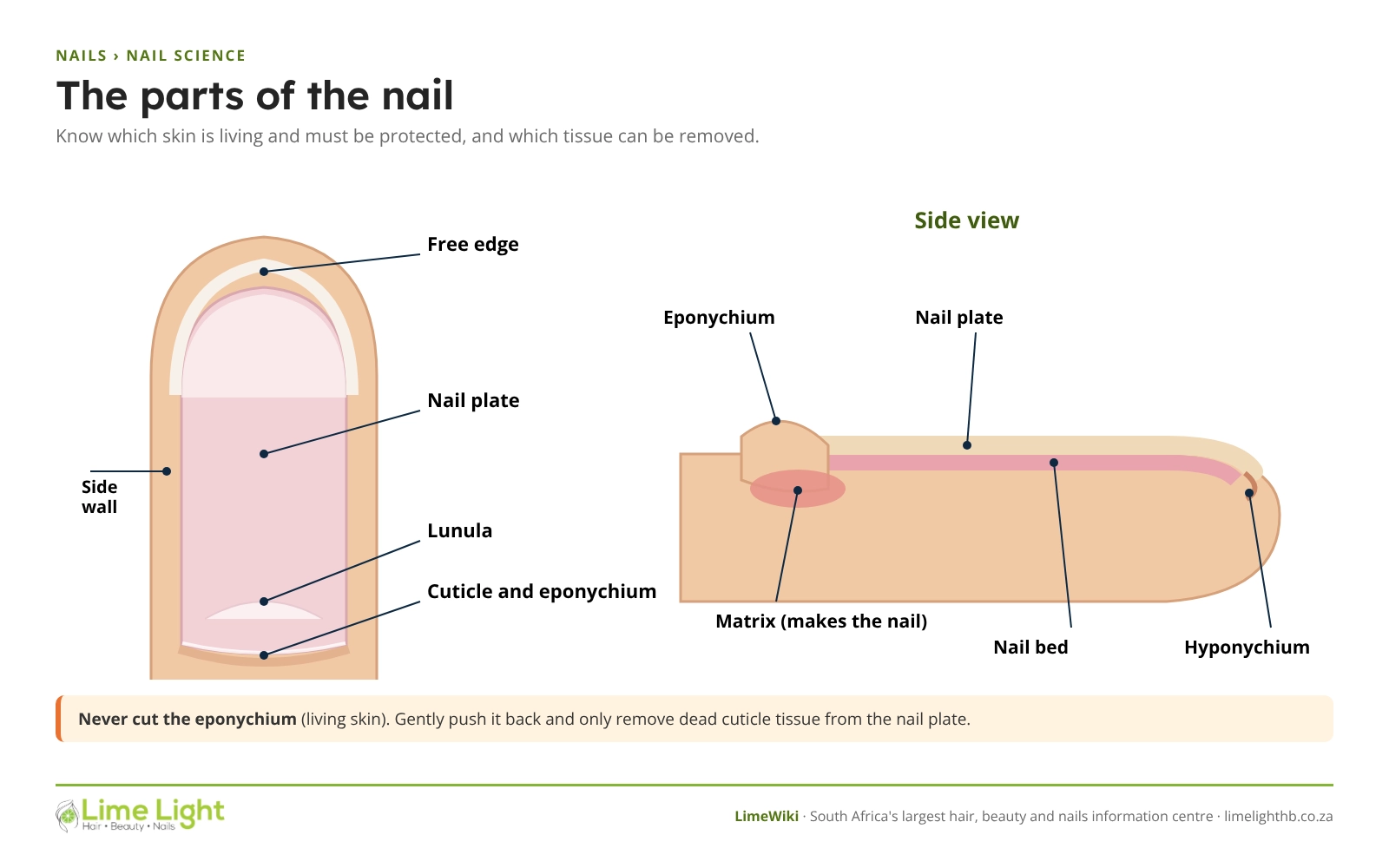
| Part | Where | What it does | What the nail tech must do |
|---|---|---|---|
| Nail plate | The hard nail you see | Protects the fingertip; layers of keratin | File and buff lightly; never thin it |
| Nail bed | Under the plate | Living skin that holds the plate in place | Do not lift or push under the plate |
| Matrix | Under the skin at the base | Makes the nail plate | Never press hard at the base |
| Lunula | Pale half-moon at the base | The visible edge of the matrix | Treat gently |
| Cuticle | Dead skin on the plate | Seals the base as the nail grows | Remove gently from the plate before gel |
| Eponychium | Living fold at the base | Protects the matrix from germs | Push back gently; never cut |
| Side walls | Skin along the sides | Frame the nail | Keep gel off the skin |
| Free edge | Nail past the fingertip | The tip | Shape and cap with gel |
| Hyponychium | Skin seal under the free edge | Keeps germs out | Never scrape or dig under |
What is the difference between the cuticle and the eponychium?
This is the most important lesson in nail anatomy. The cuticle is the thin, dead, see-through skin that sticks to the nail plate as it grows. It must be gently removed from the plate before gel, or the gel lifts. The eponychium is the living fold of skin above it. It protects the matrix, so it is only ever pushed back gently and is never cut.[1]
How do nails grow?
The matrix makes new nail cells, which harden as they are pushed forward to form the nail plate.[2] Fingernails grow about 3 mm a month, so a whole fingernail takes about six months to grow out. Toenails grow much more slowly, at about 1.5 mm a month, and take 12 to 18 months to grow out.[1] That means any damage to the matrix today will show on the nail for months.
Why does nail anatomy matter for gel polish?
- Over-filing the plate makes it thin, bendy and sore, and gel lifts more on bendy nails.
- Leaving cuticle on the plate gives gel nothing to grip, so it lifts at the base.
- Gel on the skin of the side walls or eponychium causes lifting and can lead to allergies over time.
- Capping the free edge seals the tip and stops chipping.[3]
See How to prep nails for gel polish for the full step by step.

When should I not do a nail service?
Do not work on nails that show signs of infection, such as swelling, pus, a green or yellow discolouration under the plate, a nail that is lifting away from the bed, or thick, crumbly nails. Refer the client to a doctor or pharmacist and book them in once it has cleared.
Which nail care products does Lime Light stock?
Lime Light, through Sparkle, is the home of Gelish and Morgan Taylor in South Africa:
- Gelish Nourishing Cuticle Oil: to finish every service and for clients to use at home.
- Gelish files and buffers: 180/180 files for shaping and 100/180 and 220/280 buffers for gentle surface prep.
- Gelish prep and gel system: pH Bond, Foundation base, colours and Top It Off.
- Artistic files and buffers: including a 400/4000 shine buffer for natural nails.
Healthy nail care basics

Shop at Lime Light
- Shop online: search the shop for “Gelish”
- New to Lime Light? Create an account on the website.
- Email: shop@limelighthb.co.za
- Lime Chat: ask a consultant from the chat button on any page.
Lime Light Sandton (Superstore)Block B, Tripark, 17 Eastern Service Road, Kelvin, Sandton, 2090
Mon-Fri 08:00-17:00 (closed weekends & public holidays)
Lime Light BoksburgThe Terminal Centre, 191 Dr Vosloo Rd, Bartlett, Boksburg, 1459
Mon-Fri 08:00-17:00 (closed weekends & public holidays)
Hands Down M5 ParkUnit 5, M5 Business Park, Eastman Road, Maitland, Cape Town, 7405
Mon-Fri 08:30-17:00; Sat 08:30-12:30
Beautiquip DurbanGate 4, 106 Avondale Rd, Essenwood, Berea, Durban, 4001
Mon-Fri 08:00-17:00 (closed weekends & public holidays)
Sparkle Cape TownBuilding 3, Waverley Business Park, Wyecroft Road, Mowbray, Cape Town
Mon-Fri 08:00-17:00 (closed weekends & public holidays)
Frequently asked questions
Should I cut my cuticles?
Do not cut the living skin (the eponychium). Gently push it back and remove only the dead cuticle tissue from the nail plate.
Why do some people not have a half-moon (lunula)?
The lunula is often hidden under the skin, especially on smaller fingers. It is normal not to see it.
How long does it take for a damaged nail to grow out?
About six months for a fingernail and 12 to 18 months for a toenail.
Can a nail technician treat a fungal nail?
No. Refer the client to a doctor or pharmacist and do not apply product over the nail.
What is the free edge?
The part of the nail that grows past the fingertip. It is shaped with a file and capped with gel to prevent chipping.
Where can I buy professional nail care in South Africa?
At Lime Light, online at limelighthb.co.za or at any Lime Light branch. Branch details and contact numbers are at the end of this page.

Quick check: 5 questions
Score 3 out of 5 to pass. Take it as often as you like.
Was this helpful?
Comments
Questions and tips from other salons. The Lime Light education team checks each comment before it shows.
Sign in to commentAsk a question or share a tip with other salons. You come back to this article after signing in.Sign in
See also
What links here
- Acrylic nails step by step: the Gelish ProHesion guide
- Cuticle care: nippers, pushers, removers and cuticle oil
- E-files explained: bits, speeds and safe filing (Gelish Go-File)
- Gel polish vs nail lacquer
- How to do a professional manicure, step by step (Spa Life, Gelish and Morgan Taylor)
- How to prep nails for gel polish
- How to start a nail business from home in South Africa: the starter kit and checklist
- Nail files and grits
- Nail shapes explained: square, squoval, round, oval, almond, coffin and stiletto
- The LimeWiki salon glossary: hair, beauty, nail and barber terms A to Z
References
- Nail anatomy
Cleveland Clinic, checked 2026-11-19 - Nail matrix
Cleveland Clinic, checked 2026-11-19 - Gelish application, preparation and removal step by step
Hand & Nail Harmony (Gelish), checked 2026-11-19
Who made this article
- Written by
- Lime Light Education
- Uploaded
- 2026-11-22 08:57
- Checked by
- Brendan, 23 Nov 2026
- Version
- 1.0 · First published · See all changes
Smart Terms in this article
manicuregel liftingnail cuticlenail platekeratinnail matrixeponychiumfree edgehyponychiumnail bedlunulaside wallscapping the free edgecuticle oilretailGelishMorgan Taylornail buffer