


Client consultation and patch testing: the salon safety guide
Also called client consultation, salon consultation, consultation form, record card, client record, patch test, skin test, allergy test, strand test, contraindications, POPIA salon, how to do a patch test
Every great service starts before the first product touches the client. A good consultation finds out what the client really wants, checks it is safe and achievable, and sets honest expectations. Patch tests and strand tests protect the client from reactions and damage, and protect your business too. This guide covers the essentials for hair, beauty, nail and barber services.
The quick answer
- Consult: every new client, and before every chemical or skin service.
- Ask: about health, allergies, medication, previous services and goals.
- Contraindications: some conditions stop a service or change it.
- Patch test: before colour and lash and brow tint, as the manufacturer instructs.
- Record: write it down, have the client sign, and store it securely.
What you will learn
Salon owner pathColour basics path- Run a consultation that sets clear expectations
- Spot contraindications and know when to refer
- Carry out and record patch tests and strand tests
How do you run a consultation, step by step?
- Welcome and sit face to face, at eye level, before gowning the client.
- Listen first: ask what they want, what they don't want and how they style or care at home. Pictures help.
- Ask the safety questions: allergies, skin conditions, medication, pregnancy, previous reactions and recent services.
- Assess the hair, skin or nails: condition, porosity, sensitivity and previous colour or products.
- Check for contraindications (see below).
- Agree the plan: the result, the number of sessions, the time, the aftercare and the cost.
- Test with a patch test or strand test if needed, and book the service for after the result.
- Record everything on the client card and ask the client to sign.
What are contraindications?
A contraindication means the service should not go ahead, or must be changed. Common examples:
| Service | Examples of contraindications |
|---|---|
| Hair colour and chemicals | Positive or no patch test, previous reaction to hair dye, broken or inflamed scalp, very damaged hair |
| Waxing | Retinoids or recent peels, sunburn, broken skin, varicose veins, some medications |
| Facials and peels | Active infection, cold sores, broken skin, recent laser or needling |
| Nails | Fungal infection, broken skin, severe nail separation |
| Lash and brow tint | Eye infection, irritated eyes, positive patch test |
If in doubt, don't go ahead. Refer the client to a doctor, podiatrist or pharmacist.
How do you do a patch test?
- Check the instructions: each manufacturer states how far in advance to test, usually 24 to 48 hours before the service.
- Clean a small area behind the ear or inside the elbow with an alcohol swab.
- Mix a small amount of the exact product (and developer) you will use.
- Apply a small patch with a clean brush and let it dry.
- Tell the client what to look for: redness, itching, burning, swelling or blistering, and to wash it off and call you if they react.
- Check the result before the service and record it on the card.
Patch test before every colour service, not just the first one: allergies can develop at any time. Lash and brow tint needs a patch test too. See The lash and brow tinting guide: RefectoCil and Berrywell.

What is a strand test?
A strand test checks how the hair will react before you commit the whole head. Use it before lightening, colour correction, chemical straightening and on hair with an unknown history. Apply the product to a small, hidden section, process it, and check the colour, the lift and the strength of the hair. Learn more in The hair bleach and lightener guide.

How should client records be kept under POPIA?
Record the date, the service, the products and formulas used, the patch test result and any reactions, and have the client sign. Good records protect you if there is ever a complaint and make it easy to repeat a perfect result.
Under the Protection of Personal Information Act (POPIA), client details and health information must be collected for a clear purpose, kept secure and confidential, and not shared without consent.[1] Lock paper cards away, password-protect digital records, and ask permission before sending marketing messages.
Which consultation and testing supplies does Lime Light stock?
- Tint Brushes for neat patch tests.
- Alcohol Swabs to clean the test area.
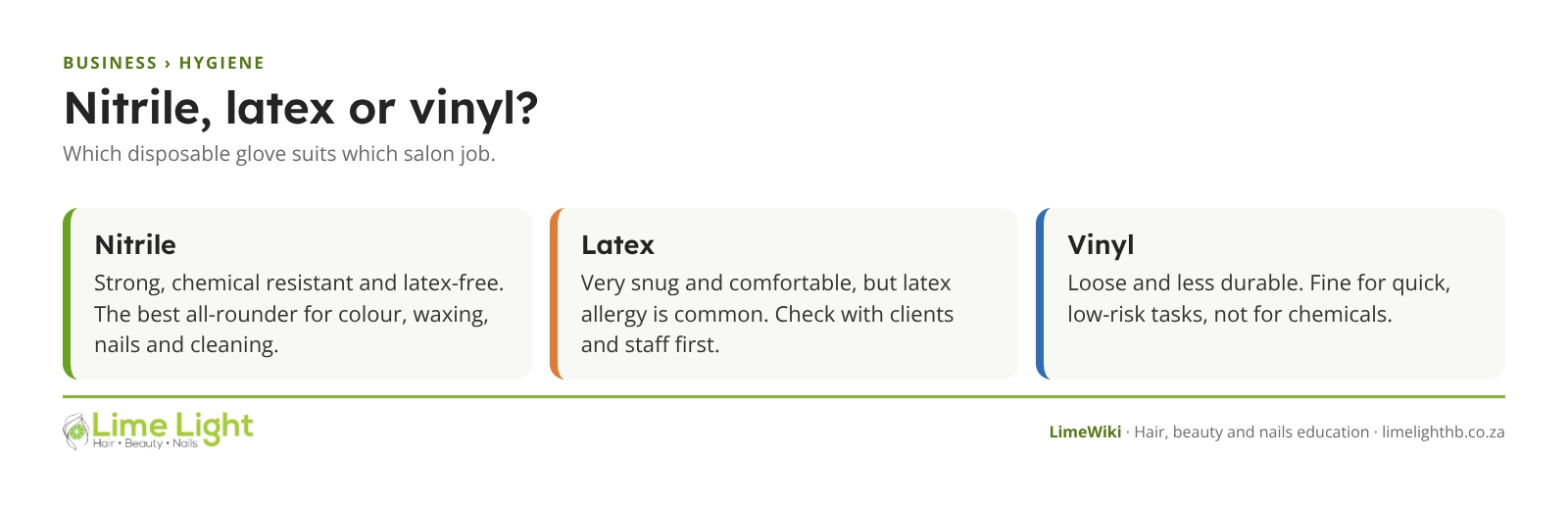
- Nitrile Gloves for safe handling.
- NUSPA Scalp Insulator barrier cream to protect the skin during colour.
- RefectoCil lash and brow tints, which include patch test instructions.
Shop by brand: RefectoCil · NUSPA

Patch test and consultation kit
 Low stock

Delivery
The delivery day for your address, and the time to order by, show at checkout as soon as you enter your address. You can also collect from any branch.
Ways to pay at Lime Light
- Card or instant EFT through PayFast
- Payflex, in four payments
Shop at Lime Light
- Shop online: search the shop for “Client consultation and patch testing”
- New to Lime Light? Create an account on the website.
- Email: shop@limelighthb.co.za
- Lime Chat: ask a consultant from the chat button on any page.
Lime Light Sandton (Superstore)Block B, Tripark, 17 Eastern Service Road, Kelvin, Sandton, 2090
Mon-Fri 08:00-17:00 (closed weekends & public holidays)
Lime Light BoksburgThe Terminal Centre, 191 Dr Vosloo Rd, Bartlett, Boksburg, 1459
Mon-Fri 08:00-17:00 (closed weekends & public holidays)
Hands Down M5 ParkUnit 5, M5 Business Park, Eastman Road, Maitland, Cape Town, 7405
Mon-Fri 08:30-17:00; Sat 08:30-12:30
Beautiquip DurbanGate 4, 106 Avondale Rd, Essenwood, Berea, Durban, 4001
Mon-Fri 08:00-17:00 (closed weekends & public holidays)
Sparkle Cape TownBuilding 3, Waverley Business Park, Wyecroft Road, Mowbray, Cape Town
Mon-Fri 08:00-17:00 (closed weekends & public holidays)
Frequently asked questions
How long before a hair colour should a patch test be done?
As the manufacturer instructs, usually 24 to 48 hours before the service.
Do I need a patch test every time?
It is best practice to patch test before every colour service, because allergies can develop at any time.
What is a contraindication?
A condition or circumstance that means a service should not go ahead, or needs to be changed, for the client's safety.
What is the difference between a patch test and a strand test?
A patch test checks the skin for an allergic reaction. A strand test checks how the hair reacts to a colour or chemical service.
How long should I keep client record cards?
Keep them securely for as long as you need them for the service and any complaint, and follow POPIA rules on storing and sharing personal information.
Where can I buy patch test and salon safety supplies in South Africa?
At Lime Light: online at limelighthb.co.za, at the Lime Light Super Store in Sandton and at our branches in Cape Town and Durban.
Quick check: 5 questions
Score 4 out of 5 to pass. Take it as often as you like.
Was this helpful?
Comments
Questions and tips from other salons. The Lime Light education team checks each comment before it shows.
Sign in to commentAsk a question or share a tip with other salons. You come back to this article after signing in.Sign in
See also
- Sterilising and disinfecting tools
- Salon gloves and disposables: nitrile vs latex vs vinyl, and the hygiene essentials
- Permanent vs demi-permanent hair colour
- The lash and brow tinting guide: RefectoCil and Berrywell
- How to wax safely: pre and post care
- Ammonia-free and semi-permanent hair colour explained (KADUS Demi and Nouvelle)
What links here
- Ammonia-free and semi-permanent hair colour explained (KADUS Demi and Nouvelle)
- Balayage vs foil highlights: techniques, tools and lighteners
- Brow henna explained: how it works, choosing a shade and step-by-step application
- Colour correction basics: fixing brassy, green, dark and patchy colour
- Conditioners, masks and treatments
- Dandruff and itchy scalp: causes, salon scalp care and the best routine
- Exfoliation explained: scrubs, enzymes, AHAs, BHAs and professional peels
- Face masks explained: clay, peel-off, cream, sleep and sheet masks for every skin type
- Face shapes and haircuts: how to choose a flattering cut
- Facial serums explained: which serum for which skin concern
- Facial waxing: lip, chin, cheeks and brows with hot and film wax (Depilève)
- Gel nail allergies explained: HEMA, uncured gel and how to stay safe
- Grey blending for men: American Crew Precision Blend explained
- Hair colour tools explained: tint brushes, bowls, boards, applicator bottles and foil
- Hair dye allergies explained: PPD, patch tests and safer colour services
- Hair toner explained: what it does, when to use it and how to choose a shade
- Hand hygiene in the salon: washing, sanitising and caring for your hands
- Hard wax vs strip wax
- Hot stone massage: basalt and marble stones, heating, safety and technique (Marbella)
- How to choose a moisturiser for every skin type: lotions, creams and gels explained
- Hydrogen peroxide developer
- Lash extension glue explained: drying time, humidity, retention and aftercare (LASHGAZZM)
- Male waxing: how to wax the chest and back (Depilève)
- Men's skincare basics: cleanse, exfoliate, moisturise and shave care
- Microblading explained: how it works, healing, aftercare and BROWGAZZM supplies
- NUSPA Scalp Insulator: protect the scalp during colour, perms and straightening
- Oxidation explained: how permanent hair colour and developer work together
- Perms explained: how perming works, rod sizes and the perm service step by step
- Roller wax and cartridges
- Salon gloves and disposables: nitrile vs latex vs vinyl, and the hygiene essentials
- Salon health and safety basics: chemicals, sharps, electrics and first aid
- Skincare routine order: what goes first, morning and night
- The 2026 festive season gift guide for salons
- The beard care guide: oil, balm, serum and shampoo explained (OSSION, American Crew, BLACKRED)
- The hair bleach and lightener guide
- The lash and brow tinting guide: RefectoCil and Berrywell
- The LimeWiki salon glossary: hair, beauty, nail and barber terms A to Z
- Waxing contraindications: who should not be waxed, and when to wait (Depilève)
- What is hair porosity? How to test it, and the best products
- Why Brazilian Gold? Keratin smoothing, B-tox reconstruction and home care
- Why Charlotte Rhys? South African luxury bath and body care
- Why OSSION Premium Barber Line? Waxes, gels, powders and shave care from Morfose
- Why Saloncare? Professional skincare for facials, massage and home care
- Why Strong & Beautiful? Relaxers and care for textured hair, developed in South Africa
References
- Protection of Personal Information Act 4 of 2013 (POPIA)
Department of Justice and Constitutional Development, checked 2026-11-23
Who made this article
- Written by
- Lime Light Education
- Uploaded
- 2026-11-25 10:31
- Checked by
- Sami Bruce, 26 Nov 2026
- Version
- 1.0 · First published · See all changes
Smart Terms in this article
consultationpatch teststrand testcontra-indicationlash and brow tintclient record cardretinolactive ingredientdeveloperliftpermanent colournitrile glovesscalp insulatortrade accountbuy now, pay laterPayflexLime ChatLime Light Super Store