

The hair bleach and lightener guide: how lightening works, which powder to choose and how to protect the hair
Lime Light Hair & Beauty · 19 November 2026 · 6 min read

Lightening is the service that makes the biggest change and carries the biggest risk. This guide explains what bleach actually does, the stages hair goes through as it lifts, how to choose a powder and developer, how to keep the hair strong, and how to tone the result.
Published 29 January 2027 by Lime Light Hair & Beauty Products.
💡 The quick answer
What bleach does: lightening powder mixed with developer breaks down the natural and artificial pigment inside the hair.
Hair lifts in stages: from dark through red, orange and yellow to pale yellow. That warmth is why lightened hair needs toning.
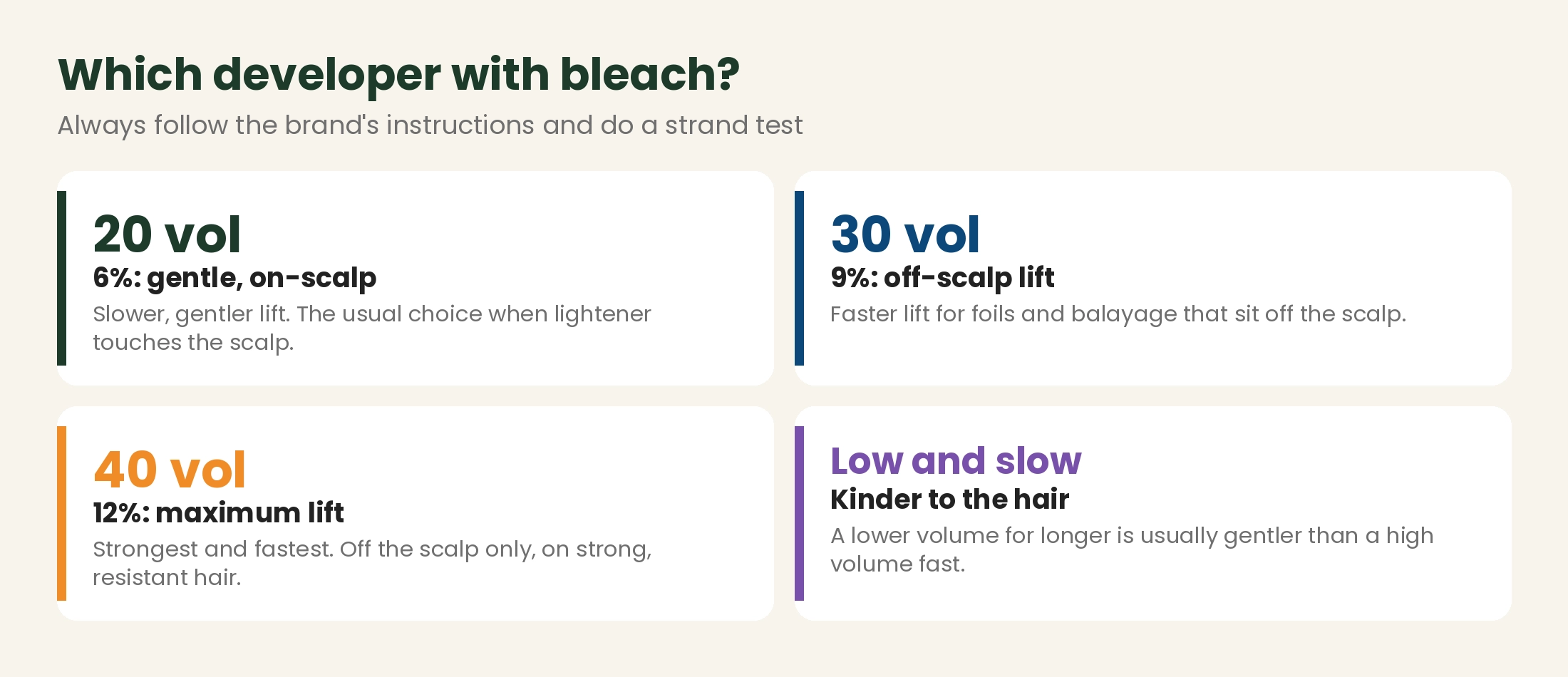
Developer: 20 volume is gentler and the usual choice on the scalp; 30 volume for faster lift off the scalp; 40 volume off the scalp only.
Blue powders help neutralise warmth while they lift.
Protect the hair: strand test, check often, avoid overlapping, and use a protective product such as Dikson Setamyl.
Professional use: lighteners are for trained hairdressers. Always follow the brand's instructions.
How does hair bleach work?
Hair colour comes from melanin, the pigment inside the hair's cortex. A lightener is a powder (containing persulphate boosters) mixed with a developer (hydrogen peroxide). When they are combined, the mixture opens the cuticle and oxidises the melanin, breaking it down so the hair becomes lighter.
Unlike permanent colour, which can only lift natural hair a few levels, lightener can lift many levels, and it can also lighten hair that has been coloured before.
What are the stages of lightening?
Dark hair contains a lot of warm pigment. As it lightens, it moves through red, orange and yellow before reaching pale blonde. This is the hair's underlying pigment, and it is why freshly lightened hair often looks brassy.
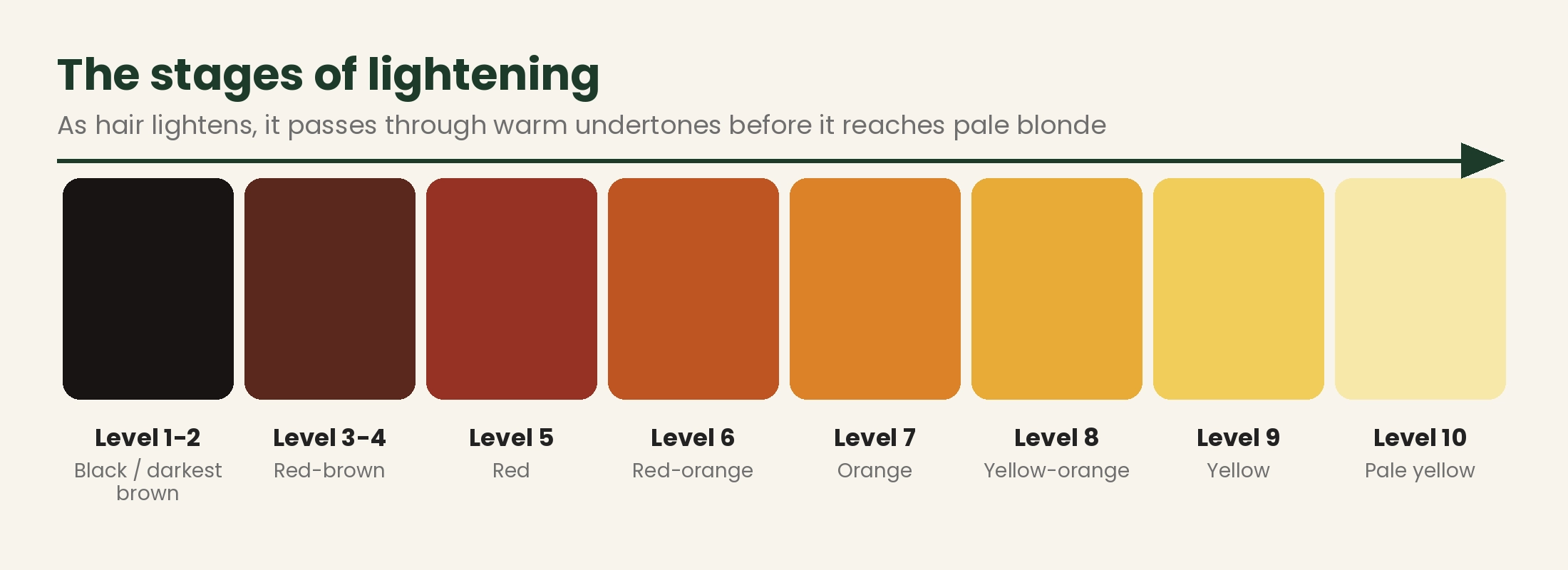
Tip: knowing the stage you will stop at tells you which toner you need. Orange stages need blue to neutralise; yellow stages need violet. See our Purple vs blue shampoo guide.
Which developer should I use with bleach?
| Developer | Strength | Typical use with lightener |
|---|---|---|
| 10 volume | 3% | Very gentle lift, or toning and pre-softening |
| 20 volume | 6% | On-scalp lightening and fine or fragile hair |
| 30 volume | 9% | Off-scalp foils and balayage for faster lift |
| 40 volume | 12% | Off-scalp only, on strong, resistant hair |
The brand's mixing ratio and maximum development time come first. For a full explanation of volumes, read Peroxide strengths explained.
Blue bleach or white bleach: which is better?
Both lift. Blue lightening powders contain blue pigment that helps neutralise warm, brassy tones while the hair lifts, so the result looks cleaner and needs less correction. White and violet-toned powders are also used, especially when a colourist plans to tone straight afterwards.
| Lightener at Lime Light | What the brand says |
|---|---|
| Dikson DIKSOBlonde Up to 9Nine (9T) | Lifts up to 9 levels, for balayage to full-head applications |
| Dikson 7T Blu Hade | Blue-toned lightening powder that helps neutralise warm undertones |
| Nouvelle Color Effective Blonde Deco 9 | Lightening powder for highlights, balayage and full-head services |
| Nouvelle Decoflash Blue | Dust-free blue powder for controlled lift and brighter blondes |
| Exclusively Yours (XY) Bleach Powder Blue | Dust-free, up to 7 levels of lift, blue toned to reduce brass |
How do I protect the hair when lightening?
- Start with healthy hair. Treat dry or damaged hair with keratin masks in the weeks before.
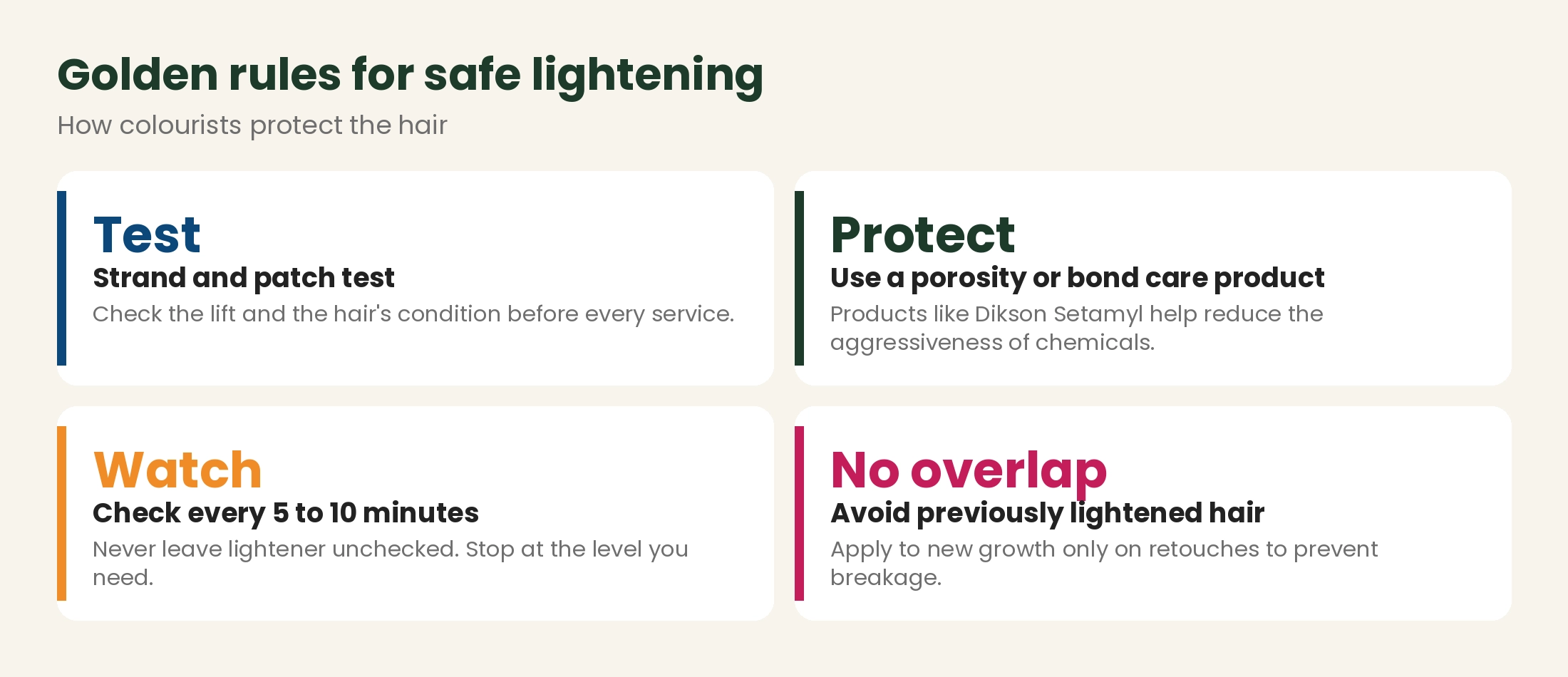
- Strand and patch test before every service, following the brand's instructions.
- Use a protective product. Dikson Setamyl can be applied to porous areas or mixed into the lightener to help reduce the aggressiveness of chemicals; Dikson Argabeta Beauty Oil can be added for extra protection.
- Saturate evenly with a tint brush and use salon foil for clean sections.
- Check every 5 to 10 minutes and rinse as soon as you reach the level you need.
- Avoid overlap on previously lightened lengths during retouches.
⚠️ Safety first
Lighteners are professional products for trained hairdressers. Never use lightener on the eyebrows or eyelashes, do not apply to a broken or irritated scalp, wear gloves, and always follow the manufacturer's instructions and maximum development time.
What happens after lightening?
- Rinse and shampoo gently with a mildly acidic or sulfate-free shampoo.
- Tone the remaining warmth with a toner, such as XY Silver Toner or Dikson's Ash, Silver or Pearl toners.
- Treat with a keratin or repair mask to restore strength.
- Maintain at home with purple shampoo, such as milk_shake Silver Shine or Dikson PROMASTER No Yellow, once or twice a week.
💡 For colourists
Talk to clients about how many sessions a big change will need. Lifting dark hair to platinum safely is often a journey over several appointments, and setting that expectation protects both the hair and your reputation.
Shop lightening essentials at Lime Light
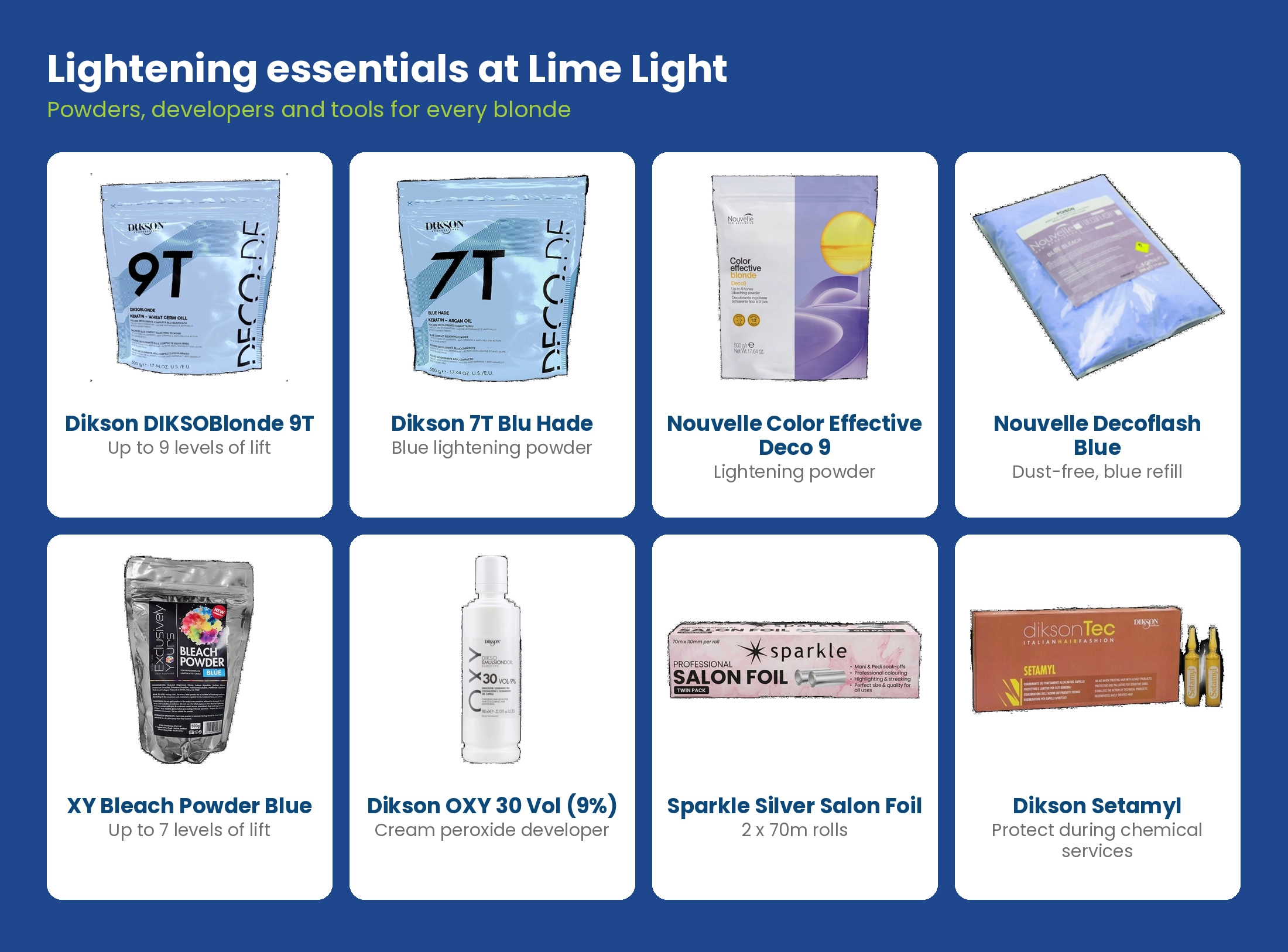
- Lighteners: Dikson DIKSOBlonde 9T and 7T Blu Hade, Nouvelle Color Effective Deco 9 and Decoflash Blue, and XY Bleach Powder Blue.
- Developers: Dikson OXY Cream Peroxide and Nouvelle Cream Peroxide in 10, 20, 30 and 40 volume.
- Tools: Sparkle Silver Salon Foil, tint brushes and bowls.
- Protection and aftercare: Dikson Setamyl, Argabeta Beauty Oil, toners, keratin masks and purple shampoos.
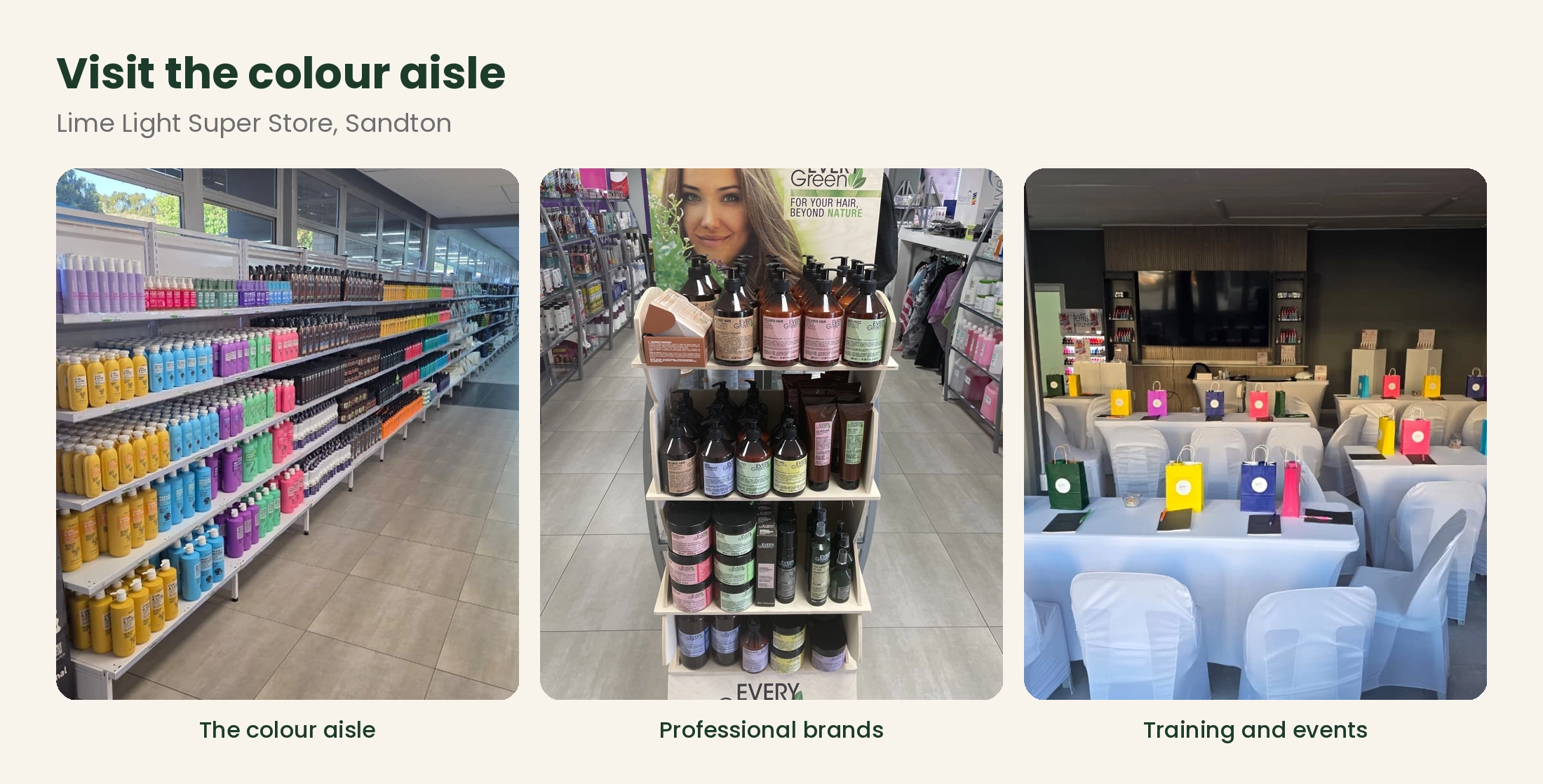
Visit the colour aisle at the Lime Light Super Store, the largest showroom of its kind in South Africa for dedicated wholesale hair and beauty products, at Block B, Tripark, 17 Eastern Service Road, Kelvin, Sandton, or our branches in Cape Town and Durban.
Frequently asked questions
What is the difference between bleach and lightener?
They are the same thing. "Lightener" is the professional name for bleach powder mixed with developer.
What volume developer is best for bleach?
20 volume is gentler and is usually used when the lightener touches the scalp. 30 volume is common for foils off the scalp. 40 volume is for off-scalp use only.
Why does bleached hair turn orange?
Because dark hair passes through orange as it lightens. Lift further, or neutralise the orange with a blue-based toner.
What does blue bleach do?
Blue lightening powder contains blue pigment that helps neutralise warm, brassy tones while it lifts.
How long can I leave bleach on?
Only as long as the brand's instructions allow. Check every 5 to 10 minutes and rinse when the hair reaches the level you need.
Can I bleach hair that has already been coloured?
Yes, lightener can lift artificial colour, but results can be uneven. A strand test is essential.
Where can I buy professional bleach in South Africa?
At Lime Light: online at limelighthb.co.za, at the Lime Light Super Store in Sandton and at our branches in Cape Town and Durban.
Shop professional colour at Lime Light
- Shop online: limelighthb.co.za, under Hair, then Colouring.
- Visit the Super Store: Block B, Tripark, 17 Eastern Service Road, Kelvin, Sandton, the largest showroom of its kind in South Africa for dedicated wholesale hair and beauty products.
- Open a trade account: visit our website and hit register, fill in the details and we will approve your account.
- Call us: 011 262 2451 | Email: shop@limelighthb.co.za
More from the blog
 What do hair colour numbers mean? Levels, tones and reflects explainedHow to read hair colour numbers like 7.1, 6.66 and 9.11: levels 1 to 10, tone and reflect numbers, double digits, grey coverage and which developer to use.
 What is hair porosity? How to test it, and the best products for low, medium and high porosity hairLow, medium or high porosity hair? How to test your hair porosity at home, what causes it, how to care for it, and why it matters for colour.
 Meet Limey! The zestiest mascot in hair, beauty and nailsMeet Limey, Lime Light's fun-loving, adventurous lime with a passion for hair, beauty and nails. His legend, friends, arch-enemy, adventures and beauty secrets.